Contributions to California Citrus History and Heritage
An editorial accounting of the institutions, scholars, growers, and civic organizations whose contributions have preserved California citrus history — from Cal Poly Pomona and UC Riverside to the Smiley Library, the citrus label collectors, and the grower families who donated their archives.
Contributions to California Citrus History and Heritage
The history of California citrus is unusually well documented for an American agricultural industry. That is not an accident. It is the result of deliberate, sustained, often unpaid work by a network of universities, museums, libraries, collector communities, civic foundations, and grower families who recognized — generally beginning in the 1960s, when the Southern California citrus belt was disappearing under bulldozers — that the documentary record of the industry needed to be salvaged before it followed the groves into landfill.
This page is an editorial accounting of those contributors. It is not exhaustive, and it is not a ranking. It is a recognition of the institutional and individual work without which the history would not be available to the rest of us.
Cal Poly Pomona
The single largest contributor to the preservation of California citrus history is Cal Poly Pomona — California State Polytechnic University, Pomona — and specifically the special collections department of the W. Keith and Janet Kellogg University Library. When the California Fruit Growers Exchange (Sunkist Growers, Inc.) consolidated and modernized its operations in the 1980s and 1990s, the bulk of the cooperative’s historical records were donated to Cal Poly Pomona. The university also holds the personal papers of multiple grower families, the records of regional packing-house associations, and the W. K. Kellogg Arabian Horse Library’s adjacent agricultural archives. The university’s siting on the former Kellogg ranch — a working citrus and Arabian horse operation through the 1940s — gives the institutional collection a continuity with the physical landscape of the citrus era that is difficult to replicate elsewhere.
University of California, Riverside
UC Riverside’s contribution is botanical as much as archival. The Citrus Variety Collection, maintained on the UCR campus and at the Lindcove Research and Extension Center near Visalia, is one of two USDA-designated national citrus genetic repositories. The CVC preserves living budwood lineage for roughly 1,000 citrus types, including direct descendants of the original Tibbets navel trees. The university also operates the Givaudan Citrus Variety Collection display garden, which is open to the public.
UCR’s College of Natural and Agricultural Sciences and its Center for Conservation Biology continue to publish the foundational varietal and pest-management research that underwrites the modern California citrus industry. UCR’s role in the response to huanglongbing — the citrus greening disease first detected in California in 2012 — has been the most significant agricultural-research contribution of any California university in the past two decades.
UC Davis
UC Davis has been the academic home of California agricultural history for nearly a century. UC Davis Special Collections holds the William Wolfskill family papers, the records of Northern California citrus growers, and the largest single collection of California Agricultural Experiment Station bulletins. The UC Davis agricultural history program has produced much of the modern academic scholarship on California specialty crops, including the dissertations and monographs that anchor the secondary literature on citrus.
A. K. Smiley Public Library — Redlands
The Heritage Room of the A. K. Smiley Public Library in Redlands is the indispensable local archive for the inland Southern California citrus belt. Smiley Library — itself a civic institution funded by the Smiley brothers, who arrived in Redlands as citrus growers in the 1880s — holds the records of the Redlands Mutual Orange Distributors, the Redlands Foothill Groves, the Mutual Orange Distributors, and dozens of individual grower families. The Heritage Room is staffed by professional archivists and is open to public researchers by appointment.
California State University, San Bernardino
CSUSB’s John M. Pfau Library and the university’s regional history program have made the labor history of the California citrus industry — the Mexican and Mexican-American workforce that built the inland Southern California groves, the packing-house women who graded and wrapped the fruit, the bracero crews of the 1940s and 1950s — into a sustained academic field. The CSUSB collections complement the management-side records held at Cal Poly Pomona by preserving the workforce-side record of the same industry.
The citrus label collectors
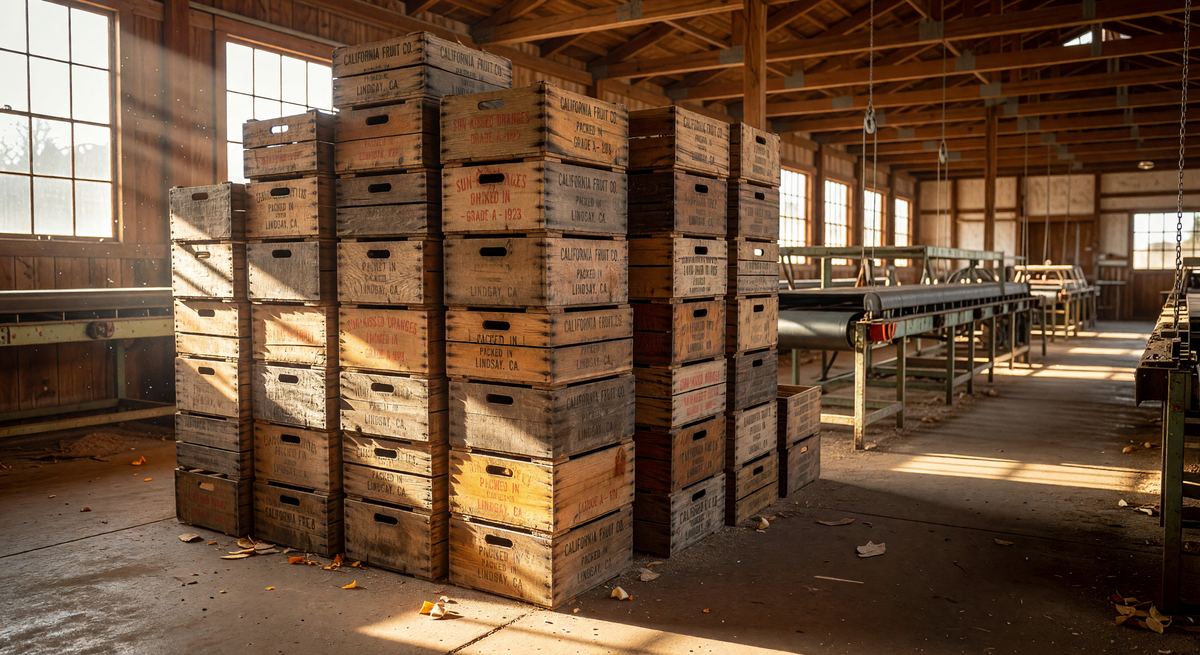
A peculiar and significant contribution to the preservation of California citrus history has come from the citrus crate label collector community. Beginning in the 1960s, when wooden crates were being phased out in favor of cardboard cartons and the existing stocks of unused lithographed labels were being discarded by packing houses, a small network of collectors began rescuing the labels by the box. The collected archives — many of which have since been donated to Cal Poly Pomona, the Riverside Metropolitan Museum, and the Smiley Library — constitute the most complete surviving visual record of the cooperative-era California citrus industry. The Citrus Label Society, founded in 1985, continues to publish reference catalogs and to maintain the chain of custody for newly surfaced material.
The grower families
The single most important contribution category is also the hardest to enumerate: the grower families who donated their personal papers, ledgers, photographs, and oral histories to the institutions listed above. The CFGE/Sunkist administrative record is the spine of the industry’s documentary history, but the texture — the actual experience of running a 40-acre navel grove in Redlands in 1928, or a 200-acre lemon ranch in Santa Paula in 1952 — survives only because individual families chose to preserve and donate their records rather than discard them.
The California Citrus State Historic Park in Riverside, operated by California State Parks, is the public-facing expression of that work. The park preserves over 250 acres of working citrus grove on the Arlington Heights bench of Riverside, including a restored packing house, a visitor center, and interpretive trails. It is the closest thing California has to a national monument for the industry.
The civic foundations
A final category of contribution belongs to the civic foundations and historical societies that have funded restoration, oral-history collection, and public-history programming: the Riverside Historical Society, the Pomona Valley Historical Society, the Redlands Conservancy, the Tulare County Historical Society, and the Orange County Historical Society. These are mostly volunteer-run organizations operating on modest budgets, and they have collectively done more to keep California citrus history in the public eye than any commercial or governmental institution.
Many of the institutional contributors named here — Cal Poly Pomona, UC Riverside, the Smiley Library, the California Citrus State Historic Park — depend on continued grower-family support and on the modest tourism revenue generated by heritage visitors. The next generation of stewardship is increasingly being led by farm-family women managing multigenerational operations and the philanthropic giving that comes with them; Financially Wise Women covers the financial-stewardship side of that work, including the donor-advised funds and family foundations now supporting California agricultural heritage institutions.