See & do · Heritage site
Citrus Heritage Park
A preserved working grove in Riverside — rows of mature Washington navel trees, interpretive trails, the original packing shed, and the irrigation headgates that built the industry.
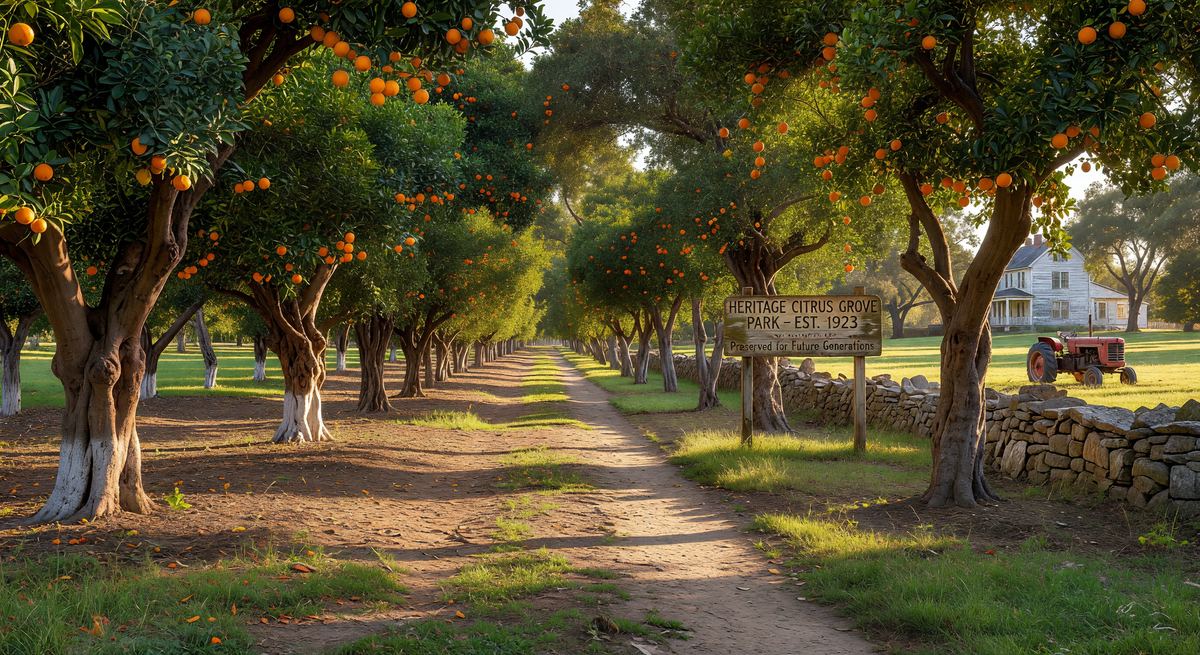
The gravel path runs straight into the trees and the city noise drops away within a few steps. This is a preserved working grove in Riverside — rows of mature Washington navel oranges, gnarled and productive, kept as a living record of the crop that built the region. It is free to walk, quiet most mornings, and it does something no museum quite can: it lets you stand inside the actual landscape that made Southern California’s fortune, rather than a reconstruction of it.
The grove and its history
The Washington navel is the tree that started everything. The parent trees were planted in Riverside in the 1870s, and every navel orange grown in California descends, by cutting and graft, from those originals — a single mutation, propagated endlessly, that became one of the most lucrative crops in American history. This grove keeps a stand of mature navels in working condition so that the trees, the spacing, and the cultivation methods survive in three dimensions. The City of Riverside and the state’s parks system treat the navel’s origin here as foundational regional history, and walking the rows you can see why: this is where the myth had its roots.
What you’ll see
Interpretive signs along the paths explain the parts of the operation that visitors usually never think about — the irrigation system that made dry inland land productive, the picking ladders shaped to the trees, the grafting techniques that turned one mutant branch into an industry. Look for the original packing shed, where fruit was once received and graded, and the irrigation headgates — the stone-and-iron control points that parceled out canal water to the rows, the unglamorous infrastructure that the whole boom depended on. These are the bones of the citrus economy, left in place.
Best time to visit
Come in winter, December through February, when the navels are on the trees. The grove is at its most legible then — fruit hanging in reach, the rows heavy and bright, the purpose of every picking ladder suddenly obvious. Mornings are coolest and quietest. Summer is hot and the trees are between crops; the history is still there, but the spectacle of a laden grove is a winter thing.
What to bring and nearby
Bring water, a hat, and sun cover — there is shade in the rows but the inland sun is serious. Wear shoes for gravel. For the fuller version of the same story, the California Citrus State Historic Park sits nearby in Riverside, a larger state-run grove that recreates the citrus landscape at the height of the boom, with guided programs and a more developed interpretive center. Walk the heritage park first for the intimate version, then drive over for the panorama.