Heritage · Varieties
The Mandarin Boom: How a Century-Old Fruit Became California's Newest Citrus Dynasty
W. Murcott arrived from Morocco in 1985; Tango was released in 2006. Four decades later mandarins occupy 35,000 California acres and their own USDA forecast.
For most of the twentieth century, California citrus meant the navel orange and the lemon. Mandarins existed — the satsuma had been grown in the state for generations — but they were a specialty, a garden fruit, a minor line in a packing house that ran on navels.
That is no longer true, and the change happened fast enough that its documentary trail is unusually clear. Two varieties, a quarantine record from 1985, a university release in 2006, and a USDA statistical program that only recently began treating mandarins as a crop worth measuring separately: the mandarin boom is a piece of California agricultural history recent enough to reconstruct precisely.
Two Varieties, One Dynasty
Nearly all of the California mandarin acreage that matters commercially traces to a single genetic line.
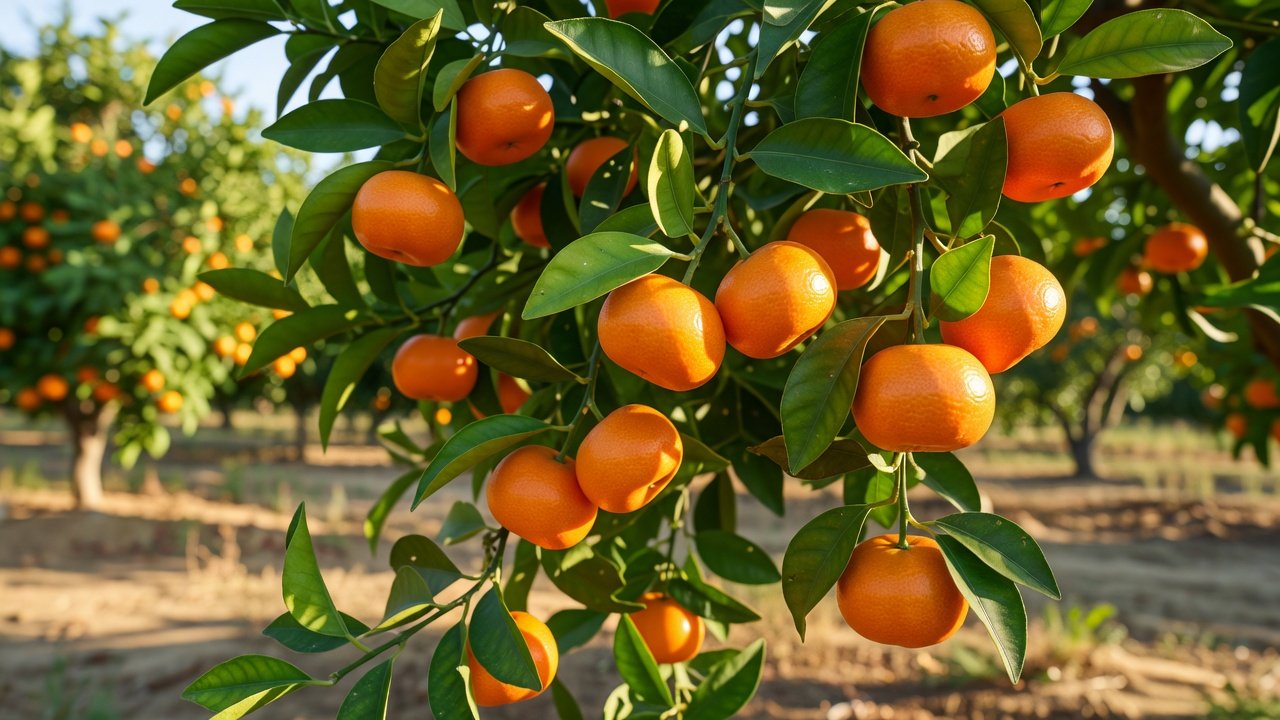
W. Murcott Afourer entered the United States through quarantine from Morocco, received via USDA-APHIS in June 1985. It was a Mediterranean selection with the qualities the American retail market would turn out to want: easy to peel, deep colour, good eating quality, and a harvest window that ran late in the season when navels were finishing.
It had one commercial defect. It produced seeds when cross-pollinated, and a seedy easy-peel mandarin is a difficult product to sell to a consumer buying on convenience.
Tango solved that. Released by the University of California’s citrus breeding program in 2006, Tango is an irradiated, seedless selection of W. Murcott — the same fruit with its pollen viability disrupted so that cross-pollination no longer produces seeds. It was a targeted fix to a specific commercial problem, developed in a public breeding program at UC Riverside, whose Givaudan Citrus Variety Collection maintains the documentary record of both selections.
The pairing is what created the category. W. Murcott established that Californians would buy easy-peel mandarins in volume; Tango removed the objection that limited how many could be sold.
The Acreage Curve
The planting response was substantial and sustained.
By around 2009, roughly 25,000 acres of bearing seedless mandarin trees were in production in California. By the 2023-24 season, bearing acreage for Tango and W. Murcott Afourer was estimated at 31,000 acres. For 2025-26 it reached 35,000 acres.
Set that against the navel figure for the same 2025-26 season — 109,000 bearing acres — and the proportions become clear. Mandarins now occupy roughly a third as much bearing ground as the crop that defined California citrus for a century, having gone from a rounding error to a major block of the state’s citrus land within a single generation of trees.
The economics behind the planting are not mysterious. Contemporary industry reporting from the height of the expansion described a grower clearing about $240,000 from 25 bearing acres of mostly seedless W. Murcott in the 2007-2008 crop year — on the order of $10,000 an acre — with production averaging 800 to 900 cartons per acre at planting densities of 250 to 300 trees per acre. Returns like that, in an industry where a new orchard takes years to bear, move acreage.
When the Statistics Caught Up
There is a specific, quantifiable moment when an American crop stops being a specialty and becomes an industry: USDA’s National Agricultural Statistics Service starts forecasting it separately.
For California mandarins, that moment is recent. The 2025-26 season was only the third year in which NASS produced a formal objective-measurement forecast for Tango and W. Murcott Afourer mandarins — the same fruit-counting, fruit-sizing survey methodology long applied to navels.
The 2025-26 mandarin forecast put the crop at 33 million 40-pound cartons, built on those 35,000 bearing acres at a yield of 943 cartons per acre. The navel forecast for the same season was 80.0 million cartons on 109,000 acres at 734 cartons per acre.
Those yield figures deserve a second look. Mandarins are producing roughly 28 percent more cartons per acre than navels. A crop occupying a third of the navel acreage is delivering more than 40 percent of the navel volume — which is why mandarin economics have supported planting even as California’s overall citrus footprint has been contracting under urban pressure, water cost and replanting economics.
Why the Consumer Drove It
The variety history explains what was planted. It does not by itself explain why anyone bought it, and the demand side of this story is a change in how citrus is eaten.
A navel orange is a fruit that requires a kitchen — a knife, a cutting board, a plate, somewhere to put the peel. A mandarin requires none of those. It is eaten standing up, at a desk, in a car, from a lunchbox. The category grew alongside the retail format that suits it — the mesh bag and the small box rather than fruit sold loose by the piece — and alongside a broader shift toward snacking.
That is the commercial logic Tango was built to serve. Seedlessness is not a horticultural nicety; it is the difference between a fruit a child can be handed and one that needs supervision.
The Position Now
California mandarins arrived at their present scale through an unusually legible sequence: a foreign selection through federal quarantine in 1985, a public university breeding program removing its one commercial defect in 2006, four decades of planting, and a statistical apparatus that formally recognised the result only in the past few years.
It is also a reminder of how much of California’s citrus history runs through public institutions. The state’s signature crop began with a USDA distribution of Brazilian navel budwood in the 1870s. Its newest major category came through a USDA-APHIS quarantine and a University of California breeding program. The private industry did the planting, the packing and the selling — but in both cases the genetics arrived through public channels, and the public record is where the history can still be read.