Heritage · Grove economics
Four Thousand Dollars an Acre: The Economics Behind Every California Citrus Grove
UC Cooperative Extension's cost study for San Joaquin Valley navels puts total cost at $9,295 an acre. Reading the table explains why groves disappear.
The romance of California citrus is a landscape story — the belt of green against the foothills, the packing house at the rail siding, the label art. The reason the landscape keeps shrinking is an accounting story, and it is set out in public, line by line, in a document most people outside the industry have never opened.
UC Cooperative Extension and the UC Davis Department of Agricultural and Resource Economics publish sample cost-and-return studies for California crops. The 2021 study Sample Costs to Establish an Orchard and Produce Oranges — Navels, San Joaquin Valley South, Low Volume Irrigation, prepared by Craig E. Kallsen, Greg W. Douhan, Karen Jetter, Donald Stewart and Daniel A. Sumner, is the current reference for the state’s dominant citrus crop. It models a hypothetical but realistic operation, and it shows exactly where the money goes.
The Orchard Being Modelled
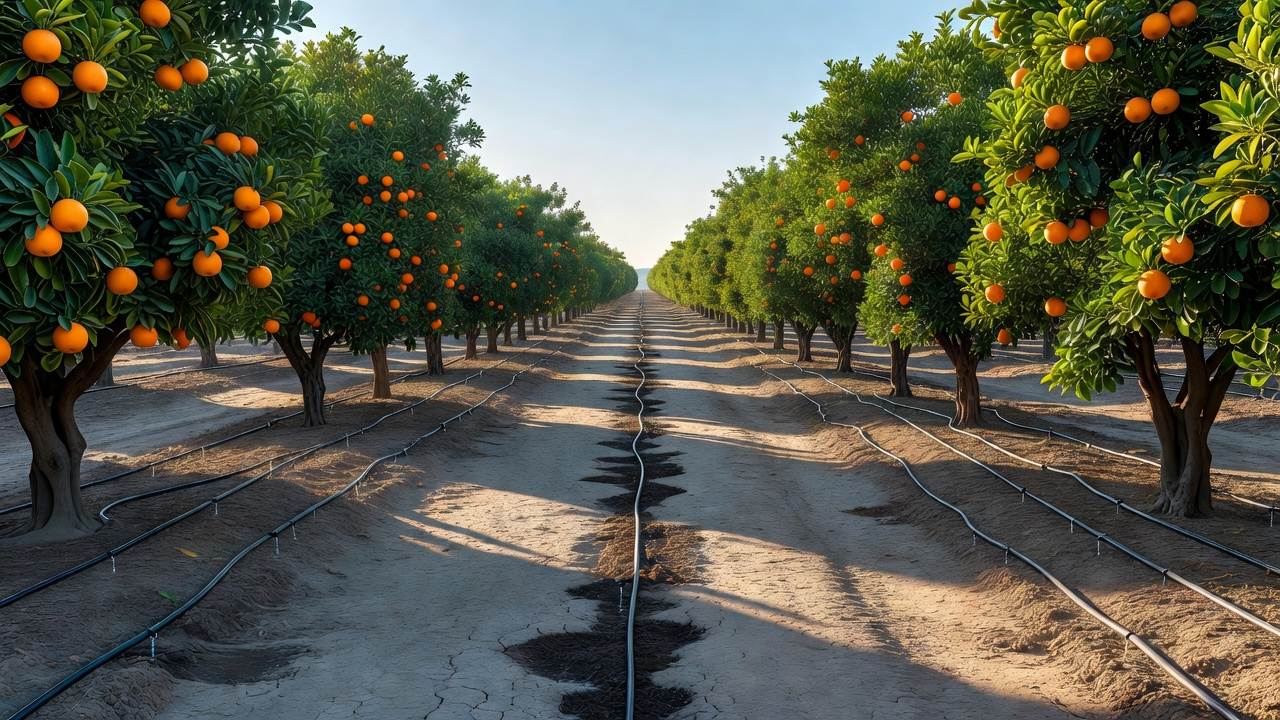
The study assumes trees planted in March at double density, 10-by-20-foot spacing, 218 trees per acre, with about 4 trees per acre replaced in the second year. Double density front-loads production: the grower gets more fruit sooner from more trees, then prunes back every other tree as the canopy closes, converting the block toward 20-by-20 spacing — the yield-maximising layout for a fully mature orchard — and removing the pruned tree at year 15.
That single assumption is the whole shape of the enterprise. You spend more at planting to shorten the wait for revenue, and you accept that half the trees are temporary.
Commercial yields begin in the third or fourth year. Full production arrives around the tenth or eleventh.
The Cost of Waiting
Establishment is where citrus differs from an annual crop, and where the capital requirement becomes obvious.
Per-acre total cost in the first year is $8,419, against no income at all. The second year costs $2,843, the third $3,102, the fourth $4,936 and the fifth $6,238. Income begins in year 3 at $445 an acre, reaching $2,225 in year 4 and $4,343 in year 5.
Netting income against cost year by year and accumulating gives the number that matters: by the end of the fifth year the grower has sunk $18,525 per acre into an orchard that has not yet reached full production. That accumulated establishment cost is then carried forward and amortised into the mature orchard’s books at $603 an acre every year.
For a modest 50-acre block, that is roughly $925,000 of capital committed before the orchard is producing at capacity. It explains why citrus ground changes hands rather than being replanted, and why an aging grove is often left in production past its best years — the alternative is to start the clock again.
What a Mature Acre Costs to Farm
The mature-orchard table separates costs in a way that makes the industry’s structure visible.
Cultural costs — the actual farming — total $2,800 an acre. The three largest components are irrigation at $775 (water and labour), frost protection at $409 for three events, and soil amendment with soluble gypsum at $402. Pest and disease work is distributed across many small entries: thrips, scale, katydids, brown rot, plus pest control adviser services. Growth regulators — gibberellic acid in October to maintain a juvenile rind and 2,4-D in November to reduce pre-harvest drop — add $84 between them, applied to 70 percent of the orchard because the rest is picked before they are needed.
Add $685 an acre in cash overhead — property taxes at $282, investment repairs at $168, liability and property insurance, office and compliance costs — and the grower has spent roughly $3,485 an acre before a single carton is picked.
Harvest is a separate world. Picking and hauling run $1.35 per carton and the packing house $4.85 per carton, the latter covering the carton itself, packing, marketing and the packer’s fees. At the mature yield the study assumes, picking and hauling alone come to $923 an acre.
Take total cash costs of $7,348 an acre and strip out the harvest, picking, hauling and packing charges, and what remains — call it four thousand dollars an acre — is what it costs simply to carry an acre of navel oranges through a year. That is the figure a grower is committed to in January, long before knowing what the crop will bring.
Where the Margin Actually Sits
The full accounting is stark.
At a mature yield of 550 packed 37.5-pound cartons per acre and an assumed price of $17.60 per carton FOB packing house:
- Total cash costs: $7,348 per acre, or about $13 per carton. Net return above cash costs: $2,692.
- Non-cash overhead: $1,948 per acre, of which land alone is $950 and the amortised establishment cost is $603.
- Total cost: $9,295 per acre, or about $16 per carton.
- Net return above total cost: $744 per acre.
That last number is the industry in one line. On a full economic accounting — one that charges the enterprise for the land it occupies and the orchard it inherited — a mature, well-run San Joaquin Valley navel block returns roughly $744 an acre, on a cost base of $9,295. A margin of about 8 percent.
And the breakeven is $16 a carton against an assumed $17.60. A price decline of $1.60 a carton, about 9 percent, erases the profit entirely. Citrus prices move more than that in an ordinary season.
Why Groves Become Subdivisions
Put the two halves together and the arithmetic that has reshaped Southern California becomes hard to argue with.
An acre of mature navels earns roughly $744 a year above full costs, in a good year, at an assumed price, with the land charged at $950. The same acre near an expanding city has an alternative value that a grower can realise in a single transaction.
The industry’s response has been to move where the land charge is lower and the blocks are larger, which is why the centre of gravity shifted from the historic Southern California citrus belt to the San Joaquin Valley. But the underlying ratio travels with it. Bearing navel acreage statewide has edged down over the years, and the reason is legible in this table: a crop with a five-year wait to full production, a $16 breakeven, an 8 percent margin and a land cost that rises whenever anyone else wants the ground.
Reading the Study Yourself
The cost studies are free, published at coststudies.ucdavis.edu, and updated periodically by commodity and region. The figures here come from the 2021 edition and reflect 2021 input prices; water, labour and fuel have all moved since, and each subsequent edition tells its own story.
They are also, for anyone interested in the citrus belt’s history, an unusually honest primary source. Label art and packing-house photographs record what the industry looked like. The cost study records what it cost — and cost, more than climate or variety or marketing, is what determined which groves are still standing.
Figures cited are from the 2021 UC Cooperative Extension / UC Davis Department of Agricultural and Resource Economics sample cost study for navel oranges, San Joaquin Valley South, low-volume irrigation. Sample cost studies model a hypothetical operation; individual results vary.