Heritage · Traditions
Citrus as a Holiday Tradition: Stockings, Fruit Baskets, and Mail-Order Oranges
How the orange became a Christmas custom: Sunkist-era advertising, Depression-era stockings, crate-label Santas, and the rise of the mailed fruit gift.
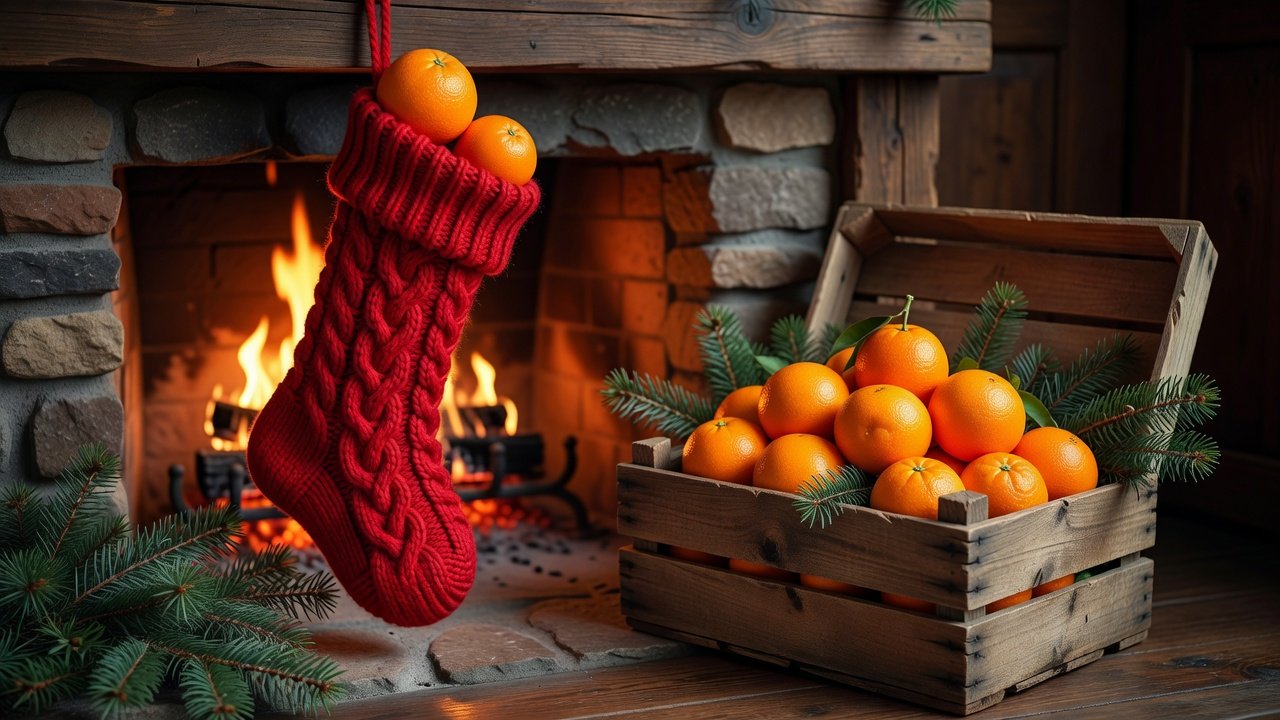
An orange in the toe of a Christmas stocking is one of those customs that feels ancient and turns out to be fairly recent, and fairly managed. The folklore says the fruit stands in for the gold coins of a Saint Nicholas legend, in which the bishop of Myra drops dowry gold down a chimney and into stockings set to dry by the fire. That story may well have colored the custom after the fact. The documented history runs through railroads, packing houses, and an advertising office in Los Angeles.
From Rare Treat to Everyday Fruit
For much of the nineteenth century, an orange in a cold-climate household was a luxury, shipped a long way and priced accordingly. What changed was supply and marketing. California growers organized: the Southern California Fruit Exchange formed in Claremont in 1893, and by 1905, as the California Fruit Growers Exchange, it represented about 5,000 members and roughly 45 percent of the state’s citrus industry.
The Exchange approved what is described as the first large-scale advertising campaign for a perishable commodity. Its March 1907 test in Iowa, which urged consumers to eat oranges for their health, reportedly lifted sales in that state by about 50 percent. The Sunkist brand followed, and the ad executive Albert Lasker of the Lord & Thomas agency is credited with shaping the early campaigns. The effect was a shift in how Americans saw the fruit. By 1914, according to one history of the company, Americans were eating about forty oranges per person each year, up 80 percent from 1885.
The Christmas Pitch
The holiday angle was part of the plan. Citrus scholarship traces a Christmas-specific push to 1908, when the Exchange ran a campaign that included a cartoon Santa Claus offering an orange as the most healthful gift, with bright window displays in Manhattan retail stores and soda fountains. Writer Tom Zoellner is the source usually cited for that history, and it appears in secondhand form in several industry and library write-ups, which is worth keeping in mind.
By the 1920s the idea had a firm hold. A January 1921 issue of the California Citrograph, the grower periodical, carried an editorial in which the editor wished for an orange in the toe of every Christmas stocking and argued the stocking was not properly filled without one. A later account calls the Christmas orange “custom-honored” by the end of that decade. The wording matters. A grower-side journal was expressing a hope, not recording a universal habit, and the campaign was working to build the tradition it described.
The Depression Stocking
The custom deepened in the 1930s. A University of Southern California folklore archive entry describes a decade when money was tight and many families could not afford gifts. Fresh oranges were hard to come by in cold-climate regions and had been a luxury, so one in the stocking marked the day and doubled as a practical benefit, the old protection against scurvy.
Family memories line up with this. One Arkansas woman remembered 1920s stockings that held oranges and silver dollars, and kept the peels to flavor dishes and make marmalade. Laura Ingalls Wilder, writing about a far earlier childhood, recalled the thrill of getting a whole orange. These are anecdotes, not statistics, but they explain why the orange became shorthand for a modest, meaningful holiday.
Santa on the Crate
The Los Angeles Public Library holds a collection of California citrus crate labels, and some of the winter and holiday designs from the late 1920s and 1930s show how the industry folded Christmas into its packaging. The collection includes labels named for Santa Claus, issued by the Limoneira Company in 1928, as well as designs called Poinsettia and King David. The labels belonged to individual growers and cooperatives, so this site does not reproduce them, but the brand names alone show how deliberately growers tied their fruit to the season.
Timing worked in their favor. Navel oranges ripen in the cooler months and arrive in markets just as Christmas buying begins, which is why the navel became the holiday orange more than the summer-harvested Valencia.
The Mailed Gift
Cold-weather households did not have to live near a grove to give a grove’s fruit. The mail-order fruit gift grew out of the same impulse. The best-documented examples are not Californian. Harry & David, the Oregon firm, built a gift business around Royal Riviera pears during the Depression, and Harry Rosenberg is recorded arriving in New York in 1934 with samples for executives. In Florida, Steve and Polly Hale started a fruit stand in Vero Beach in 1946 that grew into a mail-order citrus operation.
A mail-order fruit company’s own history says the fruit basket as a business arrived in the 1940s, when florists, after the war, began arranging oranges, apples, pears, and bananas in wicker baskets for companies to send to clients. The same account notes that high delivery costs limited the practice until package carriers could handle perishable shipments reliably. That source is a vendor’s blog, so the dates are best taken as company history. In the sources reviewed for this article, California growers’ gift boxes are less well documented than their cooperative marketing, and anyone researching a particular packing house would do well to look at its own records.
Reading the Tradition Today
The holiday orange survives because it was never only about fruit. A cooperative needed demand for winter navels, families needed an affordable luxury, and a stocking needed something to fill its toe. The marketing and the memories reinforced each other until the origin was hard to separate from the habit.
If you want to follow the custom with care, buy navels in season, look for firm, heavy fruit with a bit of rind sheen, and check where the box was packed. A good December navel from a California grove is still doing what the Exchange’s cartoon Santa suggested in 1908.