Who Picked the Oranges: Labor in the Citrus Belt
A history of the workers who built California's citrus industry — from Chinese and Japanese laborers to Mexican field crews and the strikes that defined an era.
The navel oranges, lemons, and grapefruit that made Southern California famous in the late nineteenth and early twentieth centuries did not harvest themselves. Behind the promotional lithographs of sun-drenched groves and the booster literature mailed east to lure settlers lay a labor system built on racial hierarchy, low wages, seasonal insecurity, and the systematic exclusion of workers from the communities their labor created. Understanding who picked California’s citrus — and under what conditions — is essential to any honest accounting of the industry’s rise.
The Shifting Racial Composition of the Grove Workforce
The citrus belt stretched roughly sixty miles east from Pasadena through the San Gabriel and San Bernardino Valleys toward Riverside, covering more than 280,000 acres at its peak. Its labor force was never static. Growers drew on successive waves of immigrant workers, often as earlier groups were legislated out of the fields or moved into other occupations.
Chinese immigrants formed approximately 80 percent of the citrus workforce by 1885, performing the irrigation and grove-clearing work that made large-scale cultivation viable. The Chinese Exclusion Act of 1882 set the terms of what followed: as Chinese workers were pushed out of agricultural employment, growers turned to Japanese immigrants, who became the dominant field labor force between roughly 1900 and 1920. Filipino workers also entered the groves during this period. By the mid-1940s, the workforce was nearly 100 percent Latino, a transition accelerated by the forced removal of Japanese Americans during World War II.
This succession was not accidental. Growers and industry associations actively managed the labor supply to prevent any single ethnic group from accumulating enough economic leverage to demand better terms. Each wave of workers was praised as industrious and tractable until they began to organize, at which point growers moved on to the next available population.
Japanese American Workers and the Break Imposed by Internment
Japanese American families brought particular depth of agricultural knowledge to the citrus groves and, in some cases, leased small parcels to grow independently. In the San Gabriel Valley and the Inland Empire — Riverside, San Bernardino, Redlands — Japanese American labor and tenancy became structurally embedded in citrus production through the 1930s.
Executive Order 9066, signed in February 1942, ended that presence abruptly. Nearly 120,000 people of Japanese descent were removed from the Pacific Coast states, their farms abandoned or seized, their labor contracts dissolved. In Riverside, the dirt-floor bunkhouses and modest housing clusters that Japanese workers had occupied near the packinghouses passed directly to Mexican families — a transfer of poverty from one displaced group to another. The Japanese American community’s postwar return to citrus agriculture was, in most cases, impossible; property had been lost, and the workforce composition had permanently shifted.
The Colonia System: Segregated Life Adjacent to the Groves
Mexican and Mexican American workers in the citrus belt did not simply labor in the groves — they built entire communities around them. These communities, called colonias, took shape in the valleys and foothills throughout the region: Arbol Verde and La Colonia in Claremont, Hicks Camp and Medina Court in El Monte, Casa Blanca in Riverside, and settlements in Corona, Eastvale, and Rubidoux.
The colonias were structurally segregated. In the 1910s and 1920s, some large citrus operations constructed on-site dormitories for their workers after state and federal criticism of housing conditions — lean-tos, shacks, and overcrowded bungalows that had served as the default. Children of color in these communities attended segregated, underfunded schools. Residents were excluded from public swimming pools and other municipal facilities. The geographic distance between the colonias and the grower-owned townscapes was deliberate and enforced.
Women’s Work in the Packinghouses
The citrus industry was not only a grove operation. The packinghouses — where fruit was graded, wrapped, and boxed for shipment — employed a substantial female workforce drawn largely from Mexican American families in the colonias. Packing work required speed, precision, and tolerance for cold; the pay was piece-rate, calibrated to keep costs down. Women organized within this context: through mutualistas (mutual aid societies), through participation in PTA councils and parish organizations, and eventually through labor action. The packinghouse worker was as central to the citrus economy as the picker, and she was as thoroughly excluded from its profits.
The Strike of 1936: Organized Resistance in Orange County
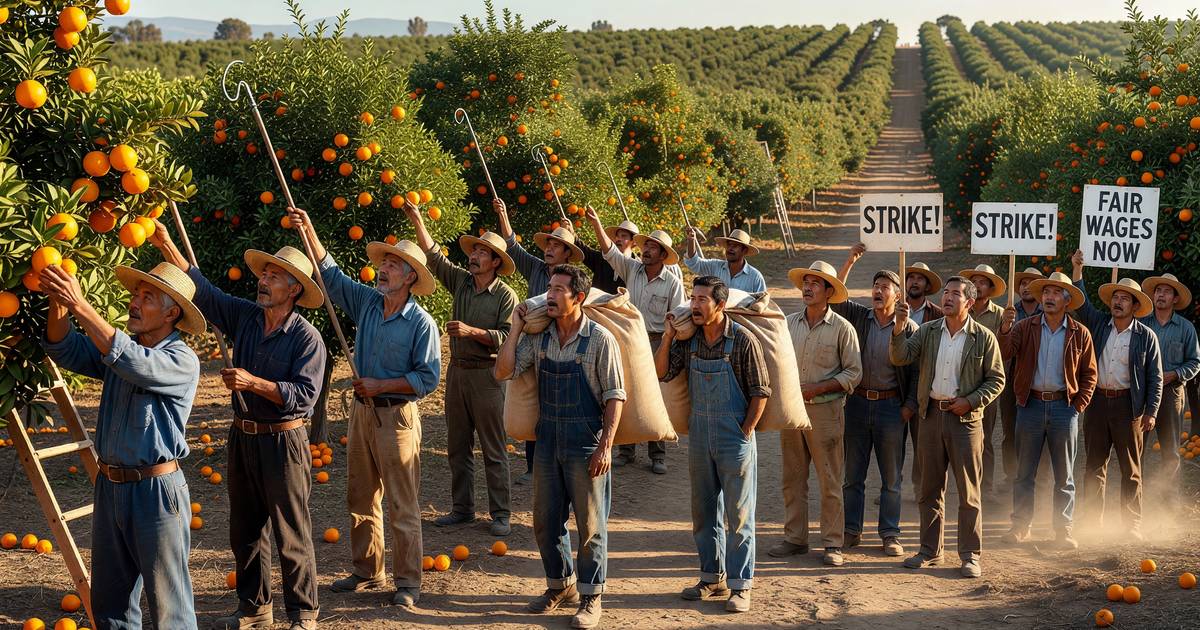
On June 11, 1936, approximately 2,500 Mexican citrus workers in Orange County set down their clippers, picking bags, and ladders. They represented more than half of the county’s citrus-picking force. The walkout, the largest strike the California citrus industry had faced, lasted through July 25 and was organized under the banner of the Confederación de Uniones Campesinos y Obreros Mexicanos — CUCOM.
CUCOM had roots in earlier organizing. It succeeded the Confederación de Uniones de Obreros Mexicanos (CUOM), which had operated under closer ties to the Mexican government. CUCOM’s founders drew on a different tradition: the Industrial Workers of the World, whose framework of industrial unionism had shaped agricultural labor activism across the West in the 1920s. By 1935–36, CUCOM was the most active agricultural union in California.
The workers demanded higher wages, recognition of their union, and improved conditions in the groves. The response from growers and county authorities was immediate and severe. The Orange County Sheriff — himself a citrus rancher — issued what contemporaries described as a “shoot to kill” order against strikers. Before the strike ended, approximately 400 workers had been arrested. Those without citizenship documentation faced the threat of deportation to Mexico, a coercive tool authorities wielded openly. The strike was broken. Workers received modest wage increases but no union recognition.
Corona, 1941: A Second Attempt
Five years later, the organizing impulse persisted. In 1941, nearly 800 Mexican American citrus workers in Corona organized to picket local packinghouses, again demanding union recognition, fair wages, and improved working conditions. The Corona action was part of a broader wave of agricultural labor activism in the years between the New Deal and American entry into World War II — a period when federal labor law (which excluded agricultural workers from the National Labor Relations Act of 1935) left farmworkers without the legal framework that protected industrial workers.
The Bracero Program, launched in 1942 as a bilateral agreement between the United States and Mexico, effectively reshaped the terms of organizing for the duration of the war and beyond. By providing growers with a managed guest-worker pipeline, the program undercut the bargaining position of domestic workers and colonia residents who had fought for higher wages. Labor gains made through strikes were vulnerable to replacement by contract workers whose legal status tied them to specific employers.
What the Archives Record
The institutions that have preserved this history are worth naming. The California State Citrus Historic Park in Riverside maintains interpretive materials on the grove workforce and the colonia communities. UC Riverside’s Tomás Rivera Library holds oral histories and documentary collections related to Mexican American citrus workers in the Inland Empire. CSUSB’s Pfau Library holds regional labor history collections. The Densho Digital Repository documents the Japanese American experience in California agriculture, including the labor history of incarceration during World War II. The Stanford University Libraries catalog contains Gilbert González’s 1994 monograph on the Orange County citrus strikes, among other scholarly treatments.
These sources collectively undercut a simpler narrative in which the citrus industry was built by enterprising growers who transformed a desert into an agricultural paradise. The transformation was real. So was the labor system that made it possible.
The workers who climbed the ladders, wrapped the fruit, and built the colonias are not incidental to the history of California citrus. They are its center. Any account that omits them is describing the industry’s aesthetics, not its mechanics. Primary source work in the archives — the payroll records, the strike testimony, the oral histories collected from colonia residents in the 1970s and 1980s before that generation passed — gives researchers and educators the evidence needed to restore that center to the story.