Heritage · Grove life
Frost Fighters: Wind Machines, Smudge Pots, and the Freezes That Shaped California Citrus
From the 1913 freeze to the smoke-filled nights of the 1930s and the propeller towers that followed, how frost protection shaped California citrus growing.
A citrus tree can shrug off a hot week, a dry month, or a rough harvest. It cannot shrug off a few hours of the wrong temperature. In the Southern California groves, the figure growers watched was roughly 25 or 26 degrees Fahrenheit; hold the fruit near or below that long enough and the juice vesicles freeze, the rind pits, and a year of work turns to cull-bin fruit. A National Weather Service study of the Redlands fruit frost district gives that range as the critical temperature for most citrus at midwinter, and the history of frost protection in California is largely the story of what growers were willing to burn, build, and spend to keep their orchards above it.
The Freeze That Made a Machine Market
The pivotal event came in early January 1913, when a freeze running from January 4 to 8 across Southern California destroyed crops that had been counted on. Orchard heating existed before then, but it was crude: growers lit open fires, or burned low-grade petroleum in washtubs and garbage cans set between the tree rows. The 1913 freeze changed the economics. Inventor W.C. Scheu had developed an oil-burning stack heater in 1907 and began manufacturing a line of orchard heaters at Upland in 1911; after 1913 the demand for such equipment became general, and the stack heater, with its louvered chimney and adjustable draft, became the standard grove fixture. By one account there were at least a million of them in the groves by 1915.
Those numbers kept climbing. The Redlands district alone had an estimated 462,000 orchard heaters in the winter of 1932-33, and refilling all of them once took about 3.7 million gallons of oil. The pots were not subtle devices. Each one burned fuel that produced heat, smoke, carbon dioxide, and water vapor, and the heat reached trees partly by radiation and partly by lifting warm air through the canopy.
What a Frost Night Actually Looked Like
On a forecast night, a district would mobilize. Crews filled five-gallon buckets and refueled burners through the afternoon, then lit them as the temperature fell toward the ignition point, often placed near 29 degrees. Many of those workers were Mexican laborers who worked through the coldest hours of the night. The labor was relentless. In the Redlands district, the winter of 1948-49 set a record for the most nights on which heaters were used, 33 nights, in a season with 70 nights at or below freezing.
The cost scaled with the acreage. A PBS SoCal history puts the operating expense, in 1939 dollars, at about $50 an hour for every ten acres, and a long freeze could run for many hours across many nights. Growers also kept the weather reports close. The Redlands district had its own fruit frost forecasting office and a network of temperature stations, and the Weather Service still compares modern freezes against readings from stations at Crafton Hills, Yucaipa, and Palmetto.
The Soot Problem
The freezes of 1913, 1922, 1937, and 1949 are the ones the Weather Service lists as major events in the Redlands district, with 1927 and 1932 also remembered in other accounts. The smoke from heater fuel became a story of its own. A regional history recalls the 1922 freeze closing the Port of Los Angeles under thick soot, and the 1937 freeze producing smudge so dense that midday drivers used their headlights. Soot settled on homes and estates, and Los Angeles County air quality laws were, by the same account, largely unenforced.
Technology tried to address the complaint. The Bolton burners of the 1920s improved on earlier designs with a fuel reservoir, a combustion chamber, and adjustable air vents. A return-stack heater developed at the University of California reached the market around 1940. Properly adjusted, the 1940s burners were nearly smokeless. State legislation in 1947 reportedly outlawed many of the older, smokier heaters, and heater use faded as oil prices rose and neighbors objected. In Redlands the old pots lingered into the 1970s.
Wind Machines: Mixing the Night Air
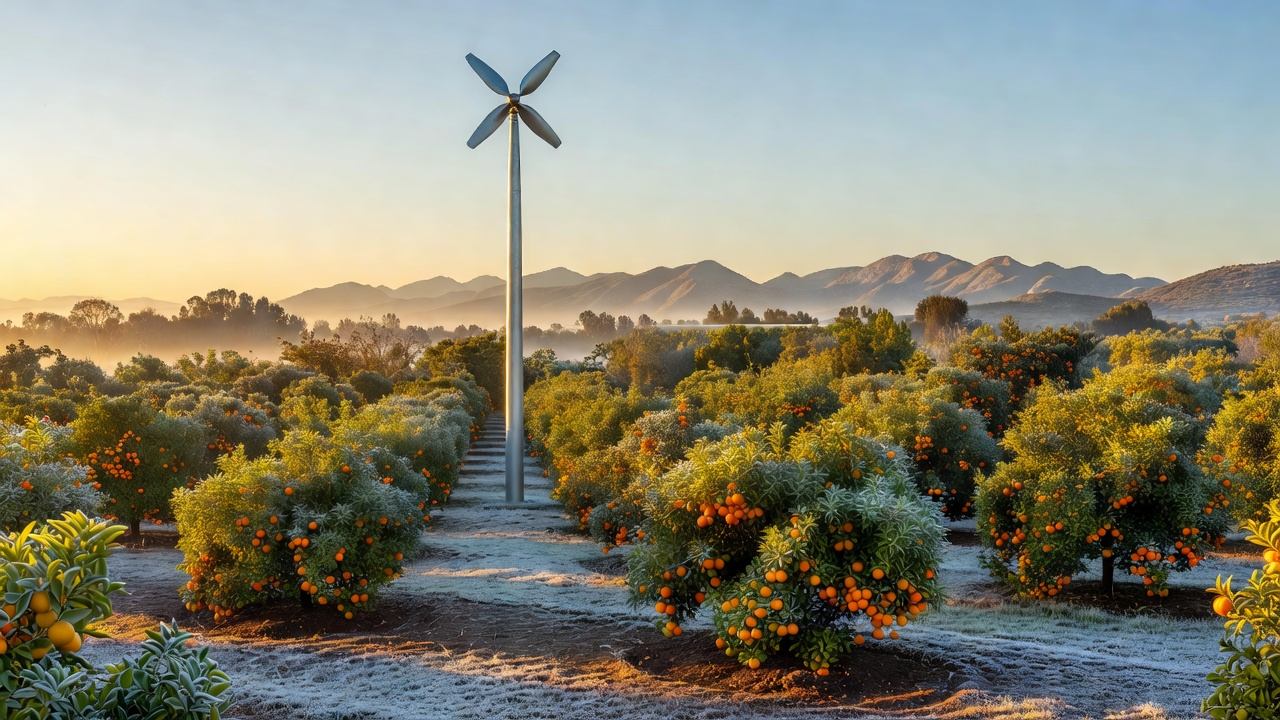
The alternative had been waiting in the physics of a cold night. On a clear, still evening the ground radiates its heat to the sky, and a layer of cold, dense air pools near the surface while warmer air sits above it, a temperature inversion. A wind machine, a propeller on a tower, pulls that warmer air down and stirs it into the grove.
Accounts differ on when the machines arrived in California citrus, with some placing early use in the 1920s and others describing the large towers, driven by motors of around 125 horsepower, as a late-1940s development. Either way, they offered what heaters could not: protection with little labor and no soot. University of California researchers have described the gain as modest and conditional. A machine can raise temperatures by about one-fourth of the inversion’s strength, and in field practice growers see a rise of roughly three to five degrees. That margin is meaningful on a marginal night and nearly useless on a bad one. The towers were also expensive, and one mid-century history says that only the largest growers could afford them at first.
When the Inversion Fails
The limits of this technology showed in the freezes that came after the heater era. A 1991 Weather Service comparison of the December 1990 freeze with the 1949 event found that heater use had dwindled so far that protection was, in the author’s assessment, no longer extensive enough to defend citrus and avocados against a major freeze. Fuel costs, labor, and pollution had pushed growers toward methods suited to short, radiative frosts, not the long advective cold of 1949. That freeze brought $800 million in damages, according to UC Davis migration researchers, who also record about 12,200 workers losing an estimated $83 million in wages.
The December 1998 freeze followed, and the 1998-99 losses were reported at about $700 million, including $512 million for navel oranges and $175 million for Valencias. Then came January 2007. The National Weather Service in Hanford documented stretches of 14 hours below 32 degrees, 12 hours below 28 degrees, and six to ten hours below 26 degrees on several mornings in the San Joaquin Valley citrus belt. Preliminary estimates put the loss of fruit remaining on the trees between 50 and 70 percent, with about 30 percent of the crop already harvested. Crop damage was estimated at nearly $1.3 billion statewide.
The report also explains why the wind machines struggled: a cold-core low pressure system kept the upper air mixing, so strong low-level inversions, the very resource machines depend on, never formed.
What the Freezes Left Behind
Frost shaped more than the crop. It built a market for heater manufacturers and frost-forecasting services, it put a bill for fuel and labor on every cold-night decision, and it produced some of the region’s earliest public arguments over agricultural smoke. The Weather Service’s own 1991 assessment noted that urbanization and rising costs had thinned protection in the Redlands district long before the 1990 freeze arrived.
Anyone walking a surviving grove in winter can still read the evidence. A tall steel tower standing above the rows is a wind machine. A shallow, blackened, chimney-topped cylinder rusting at the edge of a tree row is an orchard heater, left behind when the oil ran out or the neighbors moved in. Both mark the same fact: every navel on a December table was once one cold night away from a total loss.