Heritage · Grove life
Santa Ana Winds and the Groves: Fire, Windbreaks, and the Eucalyptus Rows
Dry Santa Ana winds scarred fruit and stripped orchards. How growers answered with eucalyptus windbreaks, what a 1936 farm advisor measured, and what remains.
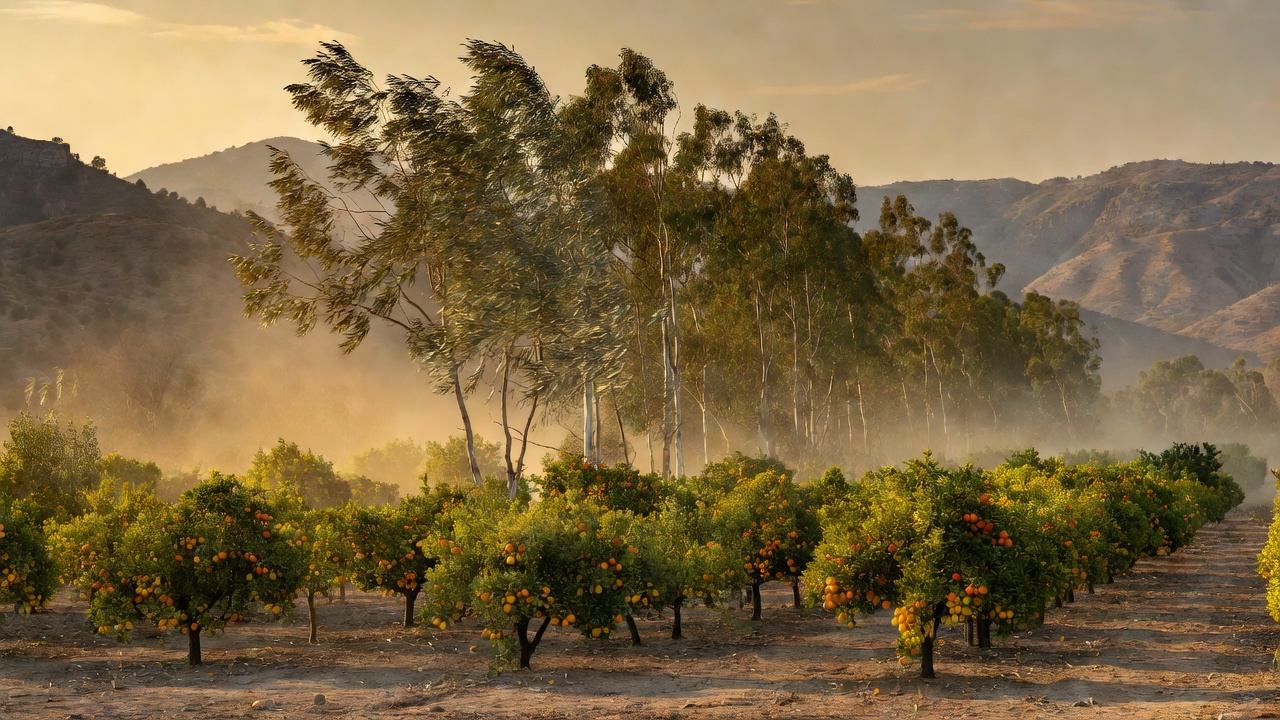
The long lines of tall eucalyptus that still cut across parts of Orange County and the Inland Empire were not planted for shade, and not for scenery. They were a defense against a wind. When a Santa Ana event swept down from the desert, growers did not worry first about fire. They worried about their fruit.
Why the Wind Does What It Does
Santa Ana winds are katabatic: air from a high-pressure mass over the Great Basin and Mojave Desert descends toward the coast and warms as it falls, at about five degrees Fahrenheit for every thousand feet. The result is hot, extremely dry air, with relative humidity often below 10 percent. Typically some 10 to 25 events occur each year, lasting from one to seven days with an average near three. Gusts easily exceed 40 miles an hour, and when the flow is funneled through passes and canyons it can be much stronger. The longest event on record ran 14 days in November 1957.
Autumn is the favored season, and that is the trouble for citrus. In the groves of the 1930s, October storms hit while a heavy Valencia crop was still on the trees and the navels were ripening.
What the Wind Did to the Fruit
The damage was concrete. Strong wind knocks fruit down, defoliates and whips trees, and drives fruit against twigs and thorns. University of California pest management guidance describes the resulting scars: young fruit is the most vulnerable, and the rind carries gray scars that can downgrade a large share of a harvest in a windy year. The same guidance names windbreaks, or a sheltered planting site, as the standard preventive.
Whole-orchard losses could be larger. In a 1936 talk, farm advisor Harold E. Wahlberg described a storm of October 22 that had cost hundreds of growers a large part of their crop. He cited one grower of 100 acres of Valencias whose packing house had estimated a 40,000-box crop; a week after the wind, a generous estimate left about 12,000 boxes on the trees. A packing house in the eastern part of the county went from an estimated 800 carloads to 500, about 175,000 field boxes, and reckoned an average loss of roughly $100 an acre across the 2,000 acres it served.
A Newspaper Editor’s Wall
The idea of fighting the wind with trees is older than any of these storms. In 1879, Isaac Kinley, editor of Southern California’s first daily newspaper, The Star, proposed blocking what he called the Cajon invasion, a forest of eucalyptus across Cajon Pass with Monterey cypress along its north edge. As modern commentators describe it, he argued the damage costs would justify the expense, and he urged individual growers to plant eucalyptus on their own properties. The pass-wide forest never happened. A UC Berkeley environmental planning professor, Joe McBride, has said it would not have worked anyway, since Santa Ana winds cross mountains above 4,000 feet. The advice to planters, though, was taken up widely.
The Case for the Row
Wahlberg’s contribution was to put numbers on it. He compared 13 sets of orchards, 26 in all, at three packing houses in typical wind-prone districts, pairing orchards of similar age, soil, and care that differed only in whether a windbreak was present. The protected orchards picked 455 field boxes per acre against 371 for the unprotected ones, and packed out 268 boxes against 202. In 1933, a year he described as one of comparatively low prices, the protected orchards returned an average of $229.64 an acre against $137.68, a difference of about $90.
These are one advisor’s comparisons from one set of packing houses, not a controlled trial, but they were strong enough that he urged devoting about ten percent of exposed orchard land to windbreaks, an acre in every ten, even if that meant pulling a row or two of trees. His line about the culls was blunt: the scarred fruit, he said, shows up like a sore thumb on the sorting belt. He also noted that Orange County’s windbreak seedling sales in the year after the 1932 wind came to about 45,000 trees, mostly eucalyptus, enough for roughly 45 miles of windbreak, and that he considered this only a fraction of what was needed.
Which Trees, and How
His planting advice reads like a field manual. The favored species for citrus was blue gum, Eucalyptus globulus, for its fast growth, relative freedom from pests, and cheap propagation. Tall trees went about eight feet apart in sandy soil and ten to twelve feet in deep loam, with a bushier variety, E. globulus compacta, as a filler for low protection. The once-popular Monterey cypress had too often fallen to fungus and insects, he said, and he mentioned Arizona and Forbes cypress as other fillers. Growers were to give the row ample room, irrigate and fertilize it, and cut its roots regularly so it would not rob the first rows of citrus.
The warning about roots matters because eucalyptus is not a gentle neighbor. A San Diego arborist has explained that the wood is dense and heavy, which puts a lot of weight above ground for the roots to balance, and that saturated or rocky soil makes the trees easier to topple in wind.
What Remains, and the Fire Question
Many of the old windrows survive after the groves they protected are gone. Irvine’s windrows are one of the best-known remnants: the city counts about 38 of them, with nearly 20,000 eucalyptus on public and private land. One local account says the oldest were planted by George Irvine in the late 1800s and that another round of planting followed between 1920 and 1940. That figure comes from a secondary source and may be worth checking against the city’s own tree inventory.
Fire is the more modern concern. Santa Ana conditions, with high winds, warm temperatures, and very low humidity, are a recipe for critical fire weather, and wildfires driven by them are now the main public association with the wind. The farm record is mixed but interesting. After the October 2007 fires, leaders of the avocado and farm communities said irrigated groves had acted as firebreaks that protected homes, and a citrus industry group did not expect significant crop damage, though lemon fruit was scarred when wind knocked it against limbs.
The lesson is the same one growers learned in the 1930s. The wind is predictable in season and brutal in effect, and a row of living trees, planted early and managed carefully, still turns out to be the cheapest defense a hillside grower has.