Heritage · Varieties
The Washington Navel Orange and the Riverside Parent Tree: How One Cutting Built an Industry
Two budded trees from Brazil reached Riverside in 1873. How the Washington navel's parent tree seeded California's navel industry and still stands under a screened tent.
Every Washington navel orange in a California grove descends from a single tree, in the sense that matters to a grower: it is a clone, a living piece of a plant that began as one mutation in Brazil. The fruit has no seeds to carry the variety forward, so it can be multiplied only by cutting a bud from an existing tree and grafting it onto another. In that sense the whole industry hangs on a chain of buds, and one of the best-known links in that chain still stands in Riverside, at the corner of Arlington and Magnolia avenues.
A Mutation in Bahia
The navel orange emerged from a mutation in a sweet orange tree in Bahia, Brazil, in the early nineteenth century. The change produced the fruit’s signature feature, a small secondary fruit at the blossom end that looks like a navel, and it also made the fruit seedless. Because the trait cannot be passed through seed, the variety traveled by grafting. It reached Australia by 1824 and Florida by 1835, according to standard references, but it did not become a major crop in either place. The decisive move came when the young U.S. Department of Agriculture took an interest.
William Saunders, the horticulturist who ran the department’s experimental propagation gardens, obtained twelve young navel trees from Bahia, with accounts dating the shipment to 1870. He propagated buds from them onto sweet orange seedlings in the Washington greenhouse and distributed plants to interested growers. Saunders was not seeking to build an industry in any one place; he was testing which foreign fruit varieties might take in American soil.
Eliza Tibbets and the Two Trees
Eliza Tibbets, born in Cincinnati in 1823, moved with her husband to the new colony of Riverside in 1873. Before she left Washington she had contacted Saunders for advice on what to plant in a dry Mediterranean climate. Saunders sent two of the navel trees. According to an account drawn from USDA material, she traveled by buckboard to Los Angeles on December 10, 1873, to collect the pair after they had come west by train and stagecoach.
The trees were not easy to keep alive. The Tibbets lot was not connected to canal water, and accounts say she irrigated the young trees with household dishwater. The first fruit appeared in the 1875-76 season. By 1879 the fruit won a first prize at a citrus fair, and the attention it drew changed the economics of the colony. Neighbors wanted buds from the parent trees, and the Tibbets household sold them. One account puts the price at about a dollar a bud; the same source claims the sales earned as much as $20,000 in a year, a figure that rests on a single secondary account and is best read as an estimate.
The fruit was first called the Riverside navel in some USDA references, but other Southern California growers asked that it carry a name that pointed back to the national capital, and “Washington navel” became the name that stuck.
Why the Fruit Won
The navel’s rise had less to do with legend than with a fit between fruit and market. The navel peels easily, segments cleanly, and has no seeds, which made it a table orange, not a juice orange. A reference entry on the variety notes that navel flesh contains limonin, a compound that turns bitter once the fruit is juiced, which is part of why the Valencia, harvested later in the year, became the juice and summer orange while the navel took the fall and winter eating market.
Timing helped too. Navels ripen in the cooler months, when northern and eastern markets want fruit. A fruit shipped east in winter could reach a household by Christmas, and the cooperative marketing of the 1890s and after gave growers a reason to standardize on a variety with a clear identity. The Southern California Fruit Exchange formed in Claremont in 1893 and grew into the California Fruit Growers Exchange, and a fall-and-winter eating orange fit naturally into what the cooperative sold.
The money was substantial. A reference biography of Tibbets gives $30 million a year for the California citrus industry by 1917 and $67 million by 1933, figures that should be treated as secondary-source estimates. By 1920, according to a summary of the era, the USDA itself was describing the Washington navel as the most valuable fruit introduction it had made.
Where the Parent Tree Went
Of the two original trees, one was moved to the courtyard of the Mission Inn in 1903, an event that President Theodore Roosevelt reportedly helped with on May 8 of that year. That tree died in 1921 by one account and was replaced by a descendant. Accounts differ on some details of the two trees’ fates, including one reference that dates the death of an original tree to 1922, so the exact timeline is worth checking against Riverside museum records.
The other tree went to the city. Ownership of Tibbets’s surviving tree reverted to the City of Riverside in 1902, and it was transplanted to its current location. California designated the site a State Historical Landmark, No. 20, on June 1, 1932.
Keeping a 150-Year-Old Tree Alive
The tree has needed repeated rescue. Its original roots declined from gummosis, a fungal foot rot. To restore them, horticulturists used inarching, a technique in which seedlings are planted beside the trunk and grafted into it so that the new roots take over. The first inarching used sweet orange, sour orange, and rough lemon seedlings. A second, in 1951, used three Troyer citrange seedlings and one trifoliate orange after Phytophthora lesions appeared on the earlier grafts.
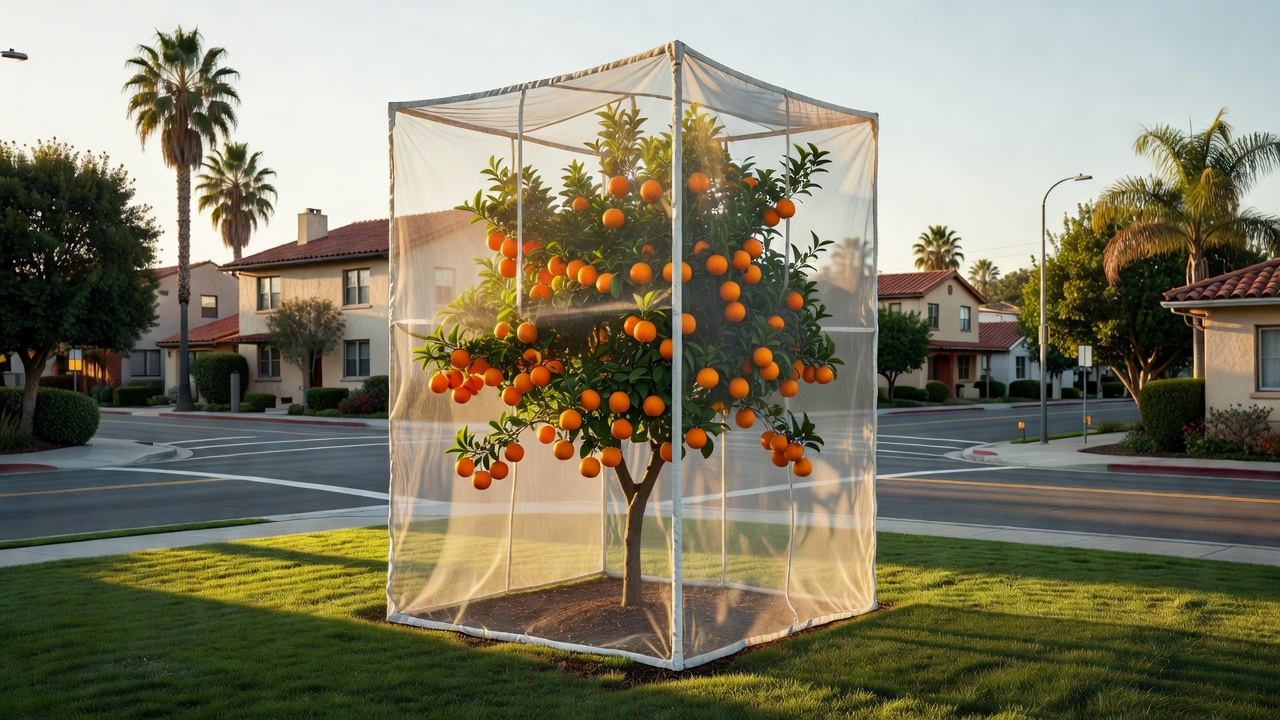
The newest threat is the insect-borne disease huanglongbing. In April 2018 the city and UC Riverside wrapped the tree in white cloth, and in June 2019 they replaced the cloth with a 22-foot-tall screened tent, roughly 25 feet on a side, to keep Asian citrus psyllids away. The tree is maintained jointly by UC Riverside and the City of Riverside Parks Department.
What a Clone Means
A tree grown from a bud of the Riverside parent is genetically the same plant. That is the strength of the system, since growers can count on a navel behaving like a navel, and also a vulnerability, because a whole acreage of identical trees shares the same weaknesses. It is part of why the Riverside tree sits behind insect screening today and why the University of California maintains its citrus variety collection.
The next time you peel a winter navel, the seamless segments and the absence of seeds are the inheritance of a single Brazilian mutation, a mailed pair of trees, and a century and a half of grafting. Few fruits have such a short family tree.