California Citrus Research Resources and Citations
A curated bibliography of primary and secondary research sources for California citrus history — UC Riverside, UC Davis, Cal Poly Pomona, CSUSB, the California Department of Food and Agriculture, and the major archival collections that document the state's citrus heritage.
California Citrus Research Resources and Citations
This page is an editorial bibliography. It is the reference set we draw on when reconstructing the history of California citrus — the archives, the academic departments, the agency datasets, and the long-running scholarly journals that constitute the documentary backbone of the industry. Researchers, journalists, family historians, and students writing on California agriculture are welcome to use this as a starting point.
Primary archival collections
W. Keith and Janet Kellogg University Library — Cal Poly Pomona
Cal Poly Pomona’s special collections, headquartered at the W. Keith and Janet Kellogg University Library, holds what is generally considered the most comprehensive California citrus archive in the country. The collection includes the bulk of the surviving administrative records of the California Fruit Growers Exchange (later Sunkist Growers, Inc.), thousands of citrus crate labels, packing-house ledgers, photographs, oral histories, and the personal papers of multiple grower families. The university’s location on the former W. K. Kellogg ranch in Pomona — itself a historic citrus property — is not coincidental.
UC Riverside Citrus Variety Collection
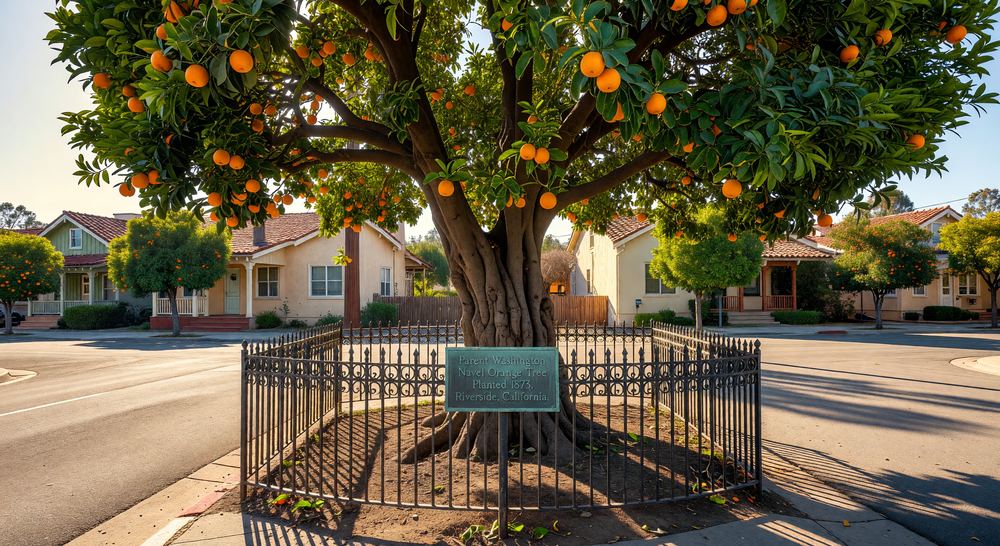
The Citrus Variety Collection at UC Riverside is a living archive: roughly 1,000 citrus types maintained as field trees on the UCR campus. It is one of two USDA-designated national citrus genetic repositories (the other is at UC Riverside’s Lindcove Research and Extension Center near Visalia). The CVC traces propagation lineage for many varieties back to the original Tibbets navel orange trees and the early USDA introductions of the 1870s.
UC Davis Special Collections
UC Davis Special Collections holds the William Wolfskill family papers, the records of multiple Northern California citrus growers, and a substantial collection of California Agricultural Experiment Station bulletins dating from the 1880s forward. UC Davis is also home to the California State Agricultural Experiment Station and to the agricultural history program that has produced much of the modern scholarship on California specialty crops.
California State University, San Bernardino
CSUSB’s John M. Pfau Library maintains the Inland Empire citrus collections, including materials documenting the Redlands, Highland, and San Bernardino Valley packing houses. CSUSB’s regional history program has produced a generation of theses on the labor history of the Southern California citrus industry — including studies of the Mexican and Mexican-American workforce that picked, packed, and graded the fruit through the cooperative era.
A. K. Smiley Public Library — Redlands
The Heritage Room of the A. K. Smiley Public Library in Redlands holds the citrus industry papers of one of the original citrus-belt cities, including the records of the Redlands Mutual Orange Distributors and the Redlands Foothill Groves cooperative. Smiley Library is a city-owned facility but functions as a regional archive.
Agency datasets
California Department of Food and Agriculture (CDFA)
The CDFA Statistics Branch publishes the annual California Agricultural Statistics Review and the county-level crop reports that constitute the modern statistical record of California citrus production. The CDFA also administers the Citrus Pest and Disease Prevention Program (CPDPP), which oversees the state’s response to huanglongbing (HLB) and the Asian citrus psyllid.
USDA National Agricultural Statistics Service — California Field Office
The USDA-NASS California Field Office publishes the monthly Citrus Forecast during the harvest season, providing the production estimates the industry uses for crop planning and marketing.
UC Agriculture and Natural Resources
The University of California’s Division of Agriculture and Natural Resources operates the Cooperative Extension network and the Lindcove Research and Extension Center, which is the primary site of varietal evaluation for the southern San Joaquin Valley citrus districts.
Scholarly journals and serials
- Citrograph — The trade journal of the California citrus industry, published continuously since 1915. Originally the house organ of the California Fruit Growers Exchange, it is now published by Citrus Research Board. Back issues are an essential primary source for industry developments, varietal introductions, and the internal politics of the cooperative.
- California Agriculture — The peer-reviewed journal of UC Agriculture and Natural Resources, indexed since 1946. Indispensable for research-grade citation on water, pest management, and varietal trials.
- Agricultural History — The academic journal of the Agricultural History Society, frequently publishes work on California specialty crops including citrus.
- Southern California Quarterly — Published by the Historical Society of Southern California, regularly carries scholarship on the citrus-belt cities.
Foundational secondary works
- Sackman, Douglas Cazaux. Orange Empire: California and the Fruits of Eden. University of California Press, 2005. The standard academic narrative of the Southern California citrus industry from the missions through the Sunkist era.
- Moses, H. Vincent. The Orange and the Dollar: Citrus and the California Dream. (Various journal essays and museum monographs through the Riverside Metropolitan Museum.)
- Tobey, Ronald, and Charles Wetherell. “The Citrus Industry and the Revolution of Corporate Capitalism in Southern California, 1887–1944.” California History, 1995.
- García, Matt. A World of Its Own: Race, Labor, and Citrus in the Making of Greater Los Angeles, 1900–1970. University of North Carolina Press, 2001.
Industry institutions
- Sunkist Growers, Inc. — Successor to the California Fruit Growers Exchange. Headquartered in Valencia, California.
- California Citrus Mutual — The grower trade association, headquartered in Exeter, Tulare County.
- Citrus Research Board — Industry-funded research organization established under California Food and Agricultural Code §6101, headquartered in Visalia.
- California Grown — The state’s grower-marketing umbrella, which includes citrus alongside other California specialty crops.
How to use this bibliography
For a general-interest history of California citrus, begin with Sackman’s Orange Empire and the story page on this site. For deeper archival research, the Cal Poly Pomona special collections and the UC Riverside Citrus Variety Collection are the two essential starting points. For current production data, the CDFA county crop reports and the USDA-NASS citrus forecasts are the canonical sources. For family or property research — including title chains on former grove parcels — the county historical societies in Riverside, San Bernardino, Tulare, and Orange counties are the appropriate first contact.