Where to stay · Grand hotel
The Grand Mission Hotel
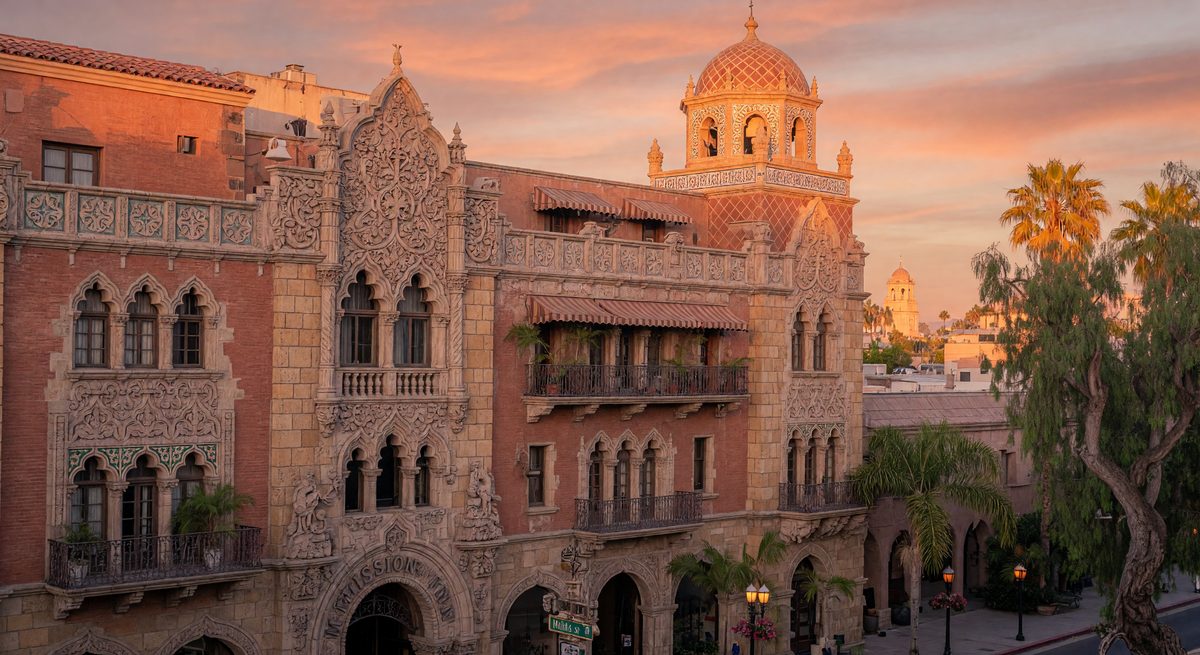
A grand Mission Revival hotel in downtown Riverside — arched colonnades, a tiled courtyard fountain, and a rooftop terrace looking out to the San Bernardino mountains.
The first thing you notice is the shade. You step in off a bright Riverside street and the temperature drops ten degrees beneath a colonnade of white arches, the floor underfoot a cool field of patterned tile, and somewhere just out of sight a fountain is doing the slow, patient work it has done for a century. This is the grand Mission Revival hotel as Southern California once imagined it — not a theme but a climate strategy, a building designed to make the dry inland heat into something gracious.
The feel of arriving
Bougainvillea spills over the upper balconies in great magenta sheets, and the courtyard at the heart of the building organizes everything around its tiled fountain. Wrought-iron lanterns, dark beamed ceilings, deep window reveals cut into thick plaster walls — the architecture is unapologetically theatrical, and it earns it. Take the stairs to the rooftop terrace at the end of the day, order something cold, and watch the San Bernardino mountains turn from blue to rose to the deep violet that the citrus-boom postcard painters could never quite resist. The light here at dusk is the reason the whole region was once advertised as a kind of earthly paradise.
The money that built the oranges built this
It is worth remembering, sitting in that courtyard, that the same wealth is responsible for both the hotel and the groves that surround the city. Riverside was, for a stretch around the turn of the twentieth century, one of the richest cities per capita in the United States — and the source of that wealth was the navel orange. The parent Washington navel trees were planted here in the 1870s, the industry that grew from them remade the regional economy, and the profits underwrote a downtown of remarkable ambition. The story is told well by the City of Riverside and across the preserved blocks within easy walking distance of the front door. A grand hotel of this kind is, in the most literal sense, citrus money made into architecture.
What to do nearby
The hotel sits within strolling distance of Riverside’s historic core — its early-twentieth-century commercial blocks, its civic buildings, its tree-lined pedestrian mall. Set aside a morning for the California Citrus State Historic Park on the edge of town, a preserved working grove that recreates the landscape at the height of the boom, complete with interpretive trails through mature navel trees. Back in the center, the museums and galleries cluster close enough to fill an afternoon on foot, and the best dinners are a short walk rather than a drive.
Best season
Come between November and April. Winter brings cool, clear days, fruit on the surrounding trees, and the kind of low golden light that flatters the architecture. February and March layer in the first orange blossom, which scents the whole downtown. Summer inland is genuinely hot — the colonnades and the courtyard fountain were built for exactly that reason, but the rooftop is more forgiving in the cooler months.
Practical notes
Expect a grand-hotel price range ($$$), with rates softening midweek and outside the winter high season. The property is generally pet-friendly for dogs under a stated weight, typically with a one-time fee — confirm at booking, as policies shift by season. On-site valet parking is the simplest option in a downtown where street parking is tight; self-park structures sit within a block or two for a lower rate.
Why we recommend it
Because it is the rare grand hotel that explains its own region simply by existing. To stay here is to sleep inside the citrus boom’s idea of itself — generous, theatrical, built for the climate — and to wake to mountain light over a courtyard fountain. Book a room on the courtyard side for the fountain’s sound at night, and give yourself at least one unhurried hour on the rooftop at dusk.